Cancellations Are Spiking, and How Hosts Can Adapt
If your Calendar has taken a beating lately with last-minute cancellations, you’re not imagining things. Over the past few months, hosts have reported more cancellations than in recent memory.
While it’s easy to point to changing traveler behavior or the current economic cycle, the reality comes down to platform dynamics. OTAs like Airbnb build tools to drive guest conversion and flexibility. Adapting to those changing rules is simply part of running a short-term rental business.
We are in the hospitality business, but we also have to run a profitable business. Here is what changed, why your market’s booking window matters more than ever, and how to build a cancellation strategy that protects your bottom line.
More Cancellations As a Result of Platform Changes
The recent wave of cancellations comes down to two specific platform updates.
First, in October 2025, Airbnb changed its long-standing cancellation policies. Under the revised Flexible and Moderate rules, if a guest cancels mid-stay, hosts are paid only for the days the guest stayed plus one additional day. The remaining days go unpaid.
Second, Airbnb introduced Reserve Now, Pay Later (RNPL). This feature allows travelers to hold dates months in advance without putting money down, usually until a few days before your cancellation policy kicks in. As a result, guests can reserve multiple properties for the same travel dates without being charged while they decide where to stay.
Worse, bad-actor guests have figured out that if they hold a reservation until a few days before check-in and cancel, hosts panic, drop their pricing, and rebook at a discount, sometimes letting those same guests rebook the property for cheaper.
Look at Your Booking Window, Not Just the Season
You can't rely on a single, set-it-and-forget-it cancellation policy anymore. Every market has its high, low, and shoulder seasons, but there’s a metric that matters even more: your booking window.
Markets vary from highly seasonal, like a winter chalet or a Mediterranean island, to year-round markets, like Miami. Understanding how guests book stays in your specific market forms the foundation of your cancellation strategy.
If a guest traditionally books a year out, a last-minute cancellation usually requires a deep discount to rebook. But if reservations are made within a week (as happened in Miami this summer), a cancellation won’t affect you as much because someone else will quickly fill those dates.
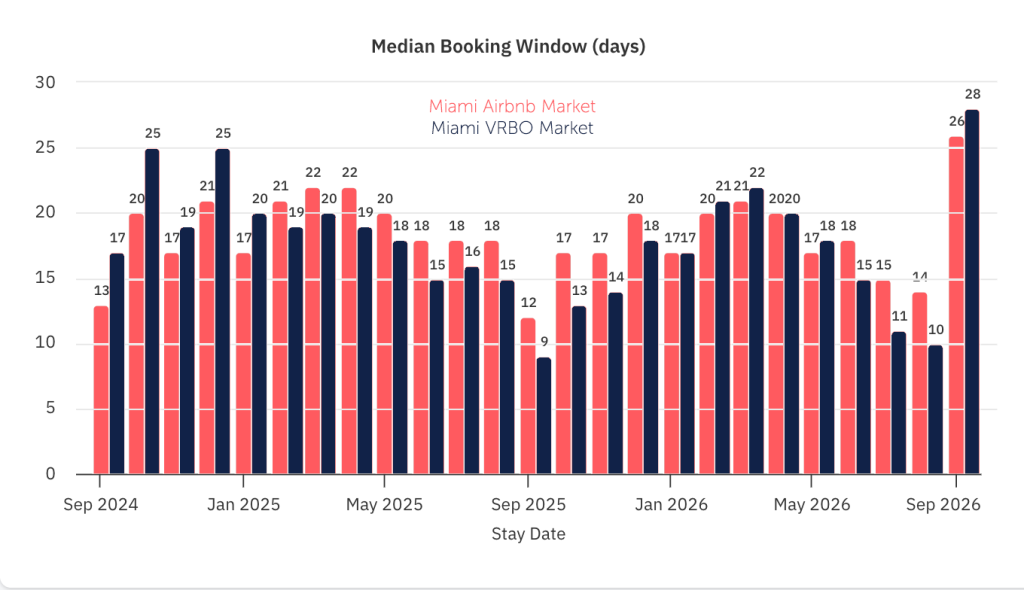
Booking windows differ by market, shift with each season, and vary by booking channel:
- High Season & Long Lead Times:
Peak dates require careful planning. Because Airbnb removed the old super-strict option, there is no longer a strict policy tier, so we suggest setting a Firm policy for your high-revenue dates (like Christmas and Art Basel) to lock in those far-out bookings. - Low Season & Flexible Terms:
Miami's low season in September and October calls for a more flexible option. In addition, if you’re not booked within your booking window, relax your cancellation policy before you drop your price.
Your minimum stay requirement follows a similar path: high season calls for longer length-of-stay requirements, while low season takes shorter reservations.
We recommend a Dynamic Cancellation Strategy
To protect your revenue without giving up the search boost OTAs give to flexible listings, you need a dynamic, seasonal strategy across your Calendar.
1. Set Your Baseline to Limited: Set your default cancellation policy to Limited. Yes, listings with flexible and moderate policies get a boost in search results, but taking that search hit is better than dealing with cancellations.
2. Protect High-Value Dates with Firm Rules: Protect your high-value, far-out dates with a Firm policy. When demand in your market is locked in months in advance, there is no reason to offer guests a risk-free option on your calendar.
3. Use Flexible and Moderate Only for Last-Minute Stays: Use Flexible and Moderate policies only when you have no bookings inside your booking window. We use the Moderate policy within a week and Flexible within 3 days, combined with shorter minimum-stay requirements and custom promotions to drive last-minute bookings.
The Bottom Line
Booking channels design tools that maximize guest conversion. Adapting to those policy changes is part of running a short-term rental business. By setting seasonal cancellation policies based on your market's actual booking windows and historical seasonal data, you maintain your rates and run a successful operation.
_____________________________________________________________________
Q: Why have short-term rental cancellations increased recently?
A: We hear of more cancellations and believe they are a result of new options introduced by OTAs, which design their tools to prioritize guest conversion and flexibility over host revenue stability.
Q: What changes did Airbnb make to Flexible and Moderate cancellation policies?
A: A guest can now cancel during their stay, and you are only paid for the days the guest stayed plus one additional night. Any remaining days don’t receive a full payout.
Q: Does the Reserve Now, Pay Later (RNPL) feature affect host calendars?
A: RNPL allows travelers to hold dates months in advance without paying for the stay until right before the cancellation policy takes effect. We’ve seen guests reserve more than one listing for the same time period while deciding which property to book. The others get canceled last minute.
Q: What should you adjust first if your calendar remains unbooked within your booking window?
A: Relax your cancellation policy before lowering your nightly price to help capture those last-minute bookings.
Q: What cancellation policy do I use as a default?
A: I set our default policy to Limited. Flexible and Moderate policies receive a search algorithm boost, but taking a slight hit in search visibility is better than managing uncompensated cancellations.
Q: How to set your cancellation policies?
A: We protect our high-value dates with a Firm cancellation policy. We shift our policy to Moderate within days and Flexible within days for unbooked nights inside our booking window shift